

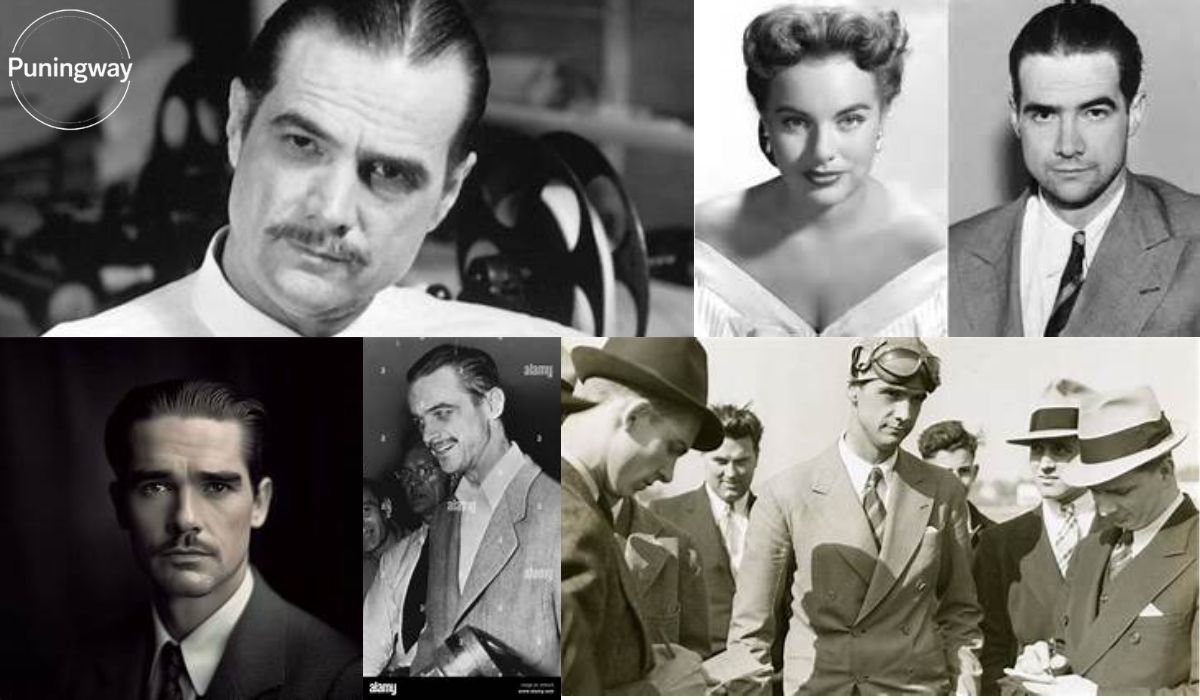
Howard Robard Hughes Jr. stands as one of America’s most fascinating figures an American business tycoon, Hollywood director and producer, aviator and engineer whose genius matched his eccentricity. Born on Christmas Eve 1905 in Houston, Texas, this billionaire lifestyle icon transformed multiple industries through sheer determination and inherited wealth, creating a financial empire that still resonates today.
The story of Howard Hughes captures the American dream’s highest peaks and darkest valleys. From producing groundbreaking Hughes films like Scarface to setting airspeed records in custom-built aircraft, Hughes lived several extraordinary lives in one. His $11 billion net worth at death (adjusted for inflation) made him one of the wealthiest Americans, yet his final years as a reclusive billionaire revealed the price of unchecked ambition and deteriorating mental health struggles.
Early Life
Howard Hughes early life began in Houston, Texas, where his father’s success as an inventor provided the foundation for future greatness. Young Howard Robard Hughes Jr. demonstrated exceptional technical aptitude, building a wireless radio transmitter at just 11 years old.
Tragedy struck the Howard Hughes family when his mother died in 1922, followed by his father’s death in 1924. At 19, Howard inherited 75% of his family’s inheritance and fortune, including the Hughes Tool Company, giving the young American business tycoon financial freedom to pursue ambitious ventures.
Early Life Highlights:
- Born December 24, 1905, in Houston, Texas
- Built wireless radio transmitter at age 11
- First flying lesson at age 14
- Attended Fessenden School and Caltech
- Inherited $500,000+ in 1924
- Became emancipated minor at 19
| Milestone | Age | Year | Impact |
| Born | 0 | 1905 | Christmas Eve |
| Radio transmitter | 11 | 1916 | Engineering talent |
| Mother dies | 17 | 1922 | First tragedy |
| Father dies | 19 | 1924 | Inheritance and fortune |
| Tool Company control | 19 | 1924 | Financial empire begins |
Hollywood Career
The Hollywood mogul launched his film industry tycoon career in 1926, producing ambitious projects that pushed creative boundaries. His directorial debut, Hell’s Angels director credit, came in 1930 with an epic war film that cost millions to produce.
Hughes’ involvement with RKO studios in 1948 marked a controversial chapter. Notable Hughes films included “The Racket,” “Arabian Nights film”, and the gangster classic where he served as Scarface producer, showcasing his vision as a Hollywood director and producer.
Major Productions:
- Hell’s Angels (1930) – $4 million epic war film
- Scarface (1932) – Crime drama classic
- The Outlaw (1943) – Controversial western
- Arabian Nights film (1927) – Box office hit
- RKO studios ownership (1948-1955)
| Film | Year | Role | Budget |
| Hell’s Angels | 1930 | Hollywood director | $4M |
| Scarface producer | 1932 | Producer | $600K |
| The Outlaw | 1943 | Director | $3M |
| RKO studios | 1948 | Owner | $9M purchase |
Aviation
The Hughes Aircraft Company founder revolutionized aerospace through innovation starting in 1932. His Hughes Helicopters division and Hughes Aerospace Group pushed technological boundaries, creating military and civilian aircraft that advanced American aviation capabilities as an aviator and engineer.
Setting multiple airspeed records, Hughes flew the H-1 Racer to unprecedented speeds. His 91-hour round-the-world flight earned him the Collier Trophy and Harmon Trophy. The massive H-4 Hercules (nicknamed Spruce Goose) remains the largest flying boat ever built.
Aviation Achievements:
- Founded Hughes Aircraft Company (1932)
- Hughes Helicopters division (1947)
- Hughes Aerospace Group (1948)
- H-1 Racer speed record: 352 mph
- Round-the-world flight: 91 hours (1938)
- Collier Trophy and Harmon Trophy winner
| Aircraft | Year | Record/Achievement | Legacy |
| H-1 Racer | 1935 | 352 mph speed record | Smithsonian |
| World flight | 1938 | 91 hours, Collier Trophy | Aviation milestone |
| H-4 Hercules | 1947 | Largest flying boat | Spruce Goose |
| XF-11 | 1946 | Nearly fatal crash | Hospital bed design |
Crash Survivals:
- 1928: Thomas-Morse Scout crash
- 1943: Lake Mead accident
- 1946: Beverly Hills XF-11 crash (nearly fatal)
- Multiple broken bones and burns
- Designed modern hospital bed prototype
Read more:Mark Rober Net Worth, Bio, Age, Family in 2025 & 26
Airline Purchases
Hughes acquired controlling interest in Trans World Airlines (TWA) starting in 1939, transforming it into a major international carrier. His $18 million order for 40 Lockheed Constellation airliners revolutionized American air travel during the post-war boom.
The Hughes Airwest venture began in 1970 when Hughes purchased Air West. This carrier eventually merged into Republic Airlines, which later became part of Northwest Airlines acquisition and ultimately Delta Air Lines.
Airline Portfolio:
- Trans World Airlines (TWA) – Majority owner 1939-1966
- Northeast Airlines – Controlled 1962-1964
- Hughes Airwest – Purchased 1970
- 40 Lockheed Constellations ordered
- Pioneered nonstop transcontinental flights
| Airline | Years | Investment | Outcome |
| TWA | 1939-1966 | Majority stake | Sold for $546M |
| Northeast | 1962-1964 | Full control | Sold to trustee |
| Hughes Airwest | 1970-1980 | $90M | Merged Republic Airlines |
| Constellation | 1939 | $18M | 40 aircraft |
Real Estate
Hughes’ property empire expanded dramatically in Las Vegas, where he owned multiple Las Vegas hotels and casinos worth an estimated $300 million. His portfolio included the legendary Desert Inn, Sands, Silver Slipper, establishing him as a dominant Vegas billionaires force.
The Landmark, Castaways, and other properties gave Hughes significant influence over city development. He also purchased 25,000 acres outside Las Vegas, 4,480 acres in Tucson, and 1,200 acres in Culver City for future development.
Vegas Casino Holdings:
- Desert Inn – Primary residence and casino
- Sands – Iconic Strip property
- Silver Slipper – Casino venue
- Landmark – Tower casino
- Castaways – Strip resort
| Property | Location | Purchase | Value |
| Desert Inn | Las Vegas | 1967 | $13M |
| Sands | Las Vegas | 1967 | $23M |
| Silver Slipper | Las Vegas | 1968 | $5.4M |
| Landmark | Las Vegas | 1969 | $17.3M |
| 25,000 acres | Nevada | 1960s | Development |
Land Holdings:
- 25,000 acres outside Las Vegas
- 4,480 acres in Tucson, Arizona
- 1,200 acres in Culver City, California
- Multiple ranch properties
- Total property empire: $300M+ investment
Relationships
Hughes’ romantic life included relationships with Hollywood’s most glamorous actresses, including Katharine Hepburn, Ava Gardner, Jean Harlow, Joan Crawford, Bette Davis, and Ginger Rogers. These Hollywood relationships reflected his status as one of cinema’s most eligible bachelors.
His marriages and divorces included two unions: first to Ella Botts Rice (1925-1929), then to actress Jean Peters (1957-1971). The marriage to Peters occurred during Hughes’ descent into his reclusive lifestyle, with the couple spending minimal time together.
Major Relationships:
- Katharine Hepburn – Serious 1930s romance
- Ava Gardner – Intense 1940s relationship
- Jean Harlow – Brief involvement
- Joan Crawford – 1920s dating
- Gene Tierney – Romantic interest
- Ginger Rogers – Proposed marriage
| Partner | Years | Type | Outcome |
| Ella Rice | 1925-1929 | First marriage | Divorced |
| Katharine Hepburn | 1936-1938 | Romance | Ended amicably |
| Ava Gardner | 1940s | Dating | Ended |
| Jean Peters | 1957-1971 | Second marriage | Divorced |
Marriage Details:
- Ella Botts Rice: 1925-1929 (no children)
- Jean Peters: 1957-1971 (lived separately)
- No biological children from either marriage
- Multiple marriage proposals to actresses
- Obsessive-compulsive disorder affected relationships
Estate Battle
Upon Hughes’ death in 1976, his estate value at death reached $2.5 billion ($11 billion inflation-adjusted), sparking one of history’s most contentious inheritance and fortune battles. Over 400 claimants emerged, including a gas station attendant claiming $150 million.
After years of litigation, a judge ruled Hughes died intestate without a valid will. The inheritance and fortune was divided among 22 distant cousins from the Howard Hughes family who became instant multimillionaires.
Estate Claimants:
- 400+ people came forward
- Melvin Dummar “Mormon Will” – claimed $150M
- Mormon Church – claimed large stake
- Multiple fake wills produced
- All wills declared fraudulent
- 22 cousins split fortune equally
| Claimant | Amount | Basis | Result |
| 22 cousins | Equal shares | Blood relatives | Won |
| Dummar | $150M | “Mormon Will” | Rejected |
| Mormon Church | Large % | Alleged will | Rejected |
| 400+ others | Various | Fake documents | Rejected |
Final Distribution:
- Total estate value: $2.5B (1976) = $11 billion (2025)
- Each cousin received $100M+
- Legal battle lasted 5+ years
- Howard Hughes Medical Institute received Hughes Aircraft stock
- No valid will ever found
Legacy
The Howard Hughes Medical Institute (HHMI) represents Hughes’ most enduring contribution, becoming one of the world’s largest biomedical research funding organizations. Founded in 1953, HHMI received all Hughes Aircraft stock upon his death.
When HHMI sold this stock to General Motors for $5.2 billion in 1985, it became one of America’s wealthiest foundations. Today, HHMI’s endowment exceeds $17 billion, supporting groundbreaking medical research globally and cementing his legacy in aviation and film.
HHMI Impact:
- Founded 1953 for biomedical research funding
- Current endowment: $17 billion
- Largest non-governmental medical funder
- Employs thousands of scientists
- Headquarters: Chevy Chase, Maryland
- Funds Nobel Prize-winning research
| Legacy Item | Year | Current Status | Value |
| HHMI | 1953 | Active foundation | $17B |
| Hughes Aircraft sold | 1985 | GM acquisition | $5.2B |
| H-1 Racer | 1935 | Smithsonian | Priceless |
| Hospital bed | 1946 | Worldwide use | Standard |
| Spruce Goose | 1947 | Museum | Tourist site |
Aviation Legacy:
- H-1 Racer at Smithsonian Museum
- H-4 Hercules / Spruce Goose in Oregon
- Airspeed records inspired pilots
- Hospital bed prototype revolutionized care
- Influence on modern aerospace engineering
Film Legacy:
- Revolutionary aerial cinematography
- RKO studios produced classics
- Launched actress careers
- Challenged censorship boundaries
- Legacy in aviation and film unique
Howard Hughes net worth at peak
Howard Hughes net worth reached its zenith during the mid-1960s when his Trans World Airlines (TWA) stake, property empire, and Hughes Aircraft Company made him worth $1.5-2 billion. Adjusted for inflation, this equals approximately $15-20 billion in 2025 dollars, making the wealthiest Americans member one of history’s richest individuals.
Howard Hughes net worth at death
Hughes’ estate value at death in 1976 totaled $2.5 billion, equivalent to approximately $11 billion net worth in 2025 dollars. This massive inheritance and fortune included Las Vegas hotels and casinos, real estate, corporate investments, and intellectual property despite his reclusive lifestyle and deteriorating health.
Howard Hughes net worth in 1930
During the 1930s, Howard Hughes biography shows his wealth primarily derived from Hughes Tool Company profits and early Hollywood investments. His financial empire was substantial enough to fund expensive Hughes films like “Hell’s Angels” and support aviation experiments, estimated at several million dollars in that era.
Howard Hughes wife
Jean Peters, Hughes’ second wife, married the OCD billionaire in 1957 and remained legally married until 1971. Their unusual marriage involved minimal contact during his reclusive lifestyle. His first marriage to Ella Botts Rice lasted 1925-1929. Neither produced Howard Hughes children.
Howard Hughes children
Howard Hughes never had biological or adopted children despite two marriages and numerous Hollywood relationships with actresses. The absence of Howard Hughes children meant his $11 billion net worth was distributed among 22 distant Howard Hughes family cousins rather than direct heirs.
Howard Hughes family
The Howard Hughes family background centered on his father, Howard Sr., who invented a revolutionary drill bit. His mother, Allene, died in 1922. Hughes had no siblings. After his death, 22 distant cousins inherited his wealth, representing the remaining Howard Hughes family connections.
Howard Hughes cause of death
Kidney failure death claimed Hughes’ life on April 5, 1976, while being transported to a Houston hospital. His drug use and addiction to codeine, combined with obsessive-compulsive disorder and years of self-neglect, left him weighing only 90 pounds at death.
Howard Hughes last photo
The Howard Hughes last photo remains mysterious as he lived his final years in extreme seclusion avoiding cameras. His mental health struggles and drug use and addiction deteriorated his appearance so dramatically that authorities needed FBI fingerprint analysis to confirm his identity after death.
Conclusion
Howard Robard Hughes Jr. transformed American aviation, entertainment, and business through relentless innovation. From setting airspeed records to producing groundbreaking Hughes films, his accomplishments spanned multiple industries. His Howard Hughes Medical Institute (HHMI) legacy continues funding vital biomedical research, ensuring his name represents both achievement and philanthropy despite his tragic reclusive lifestyle and mental health struggles in later years.
The American business tycoon left behind a complex legacy mixing brilliance with obsessive-compulsive disorder. His $11 billion net worth at death couldn’t purchase happiness or health, demonstrating money’s limitations. Yet his contributions to legacy in aviation and film remain invaluable, inspiring future generations of entrepreneurs who recognize Hughes as both cautionary tale and pioneering genius whose influence on modern aerospace endures forever.
